Running
What it looks like on a working desk.
Screenshots of the live tool on a demonstration book of 1,842 lots. You can open it and drive it yourself — the button is at the end of this page.
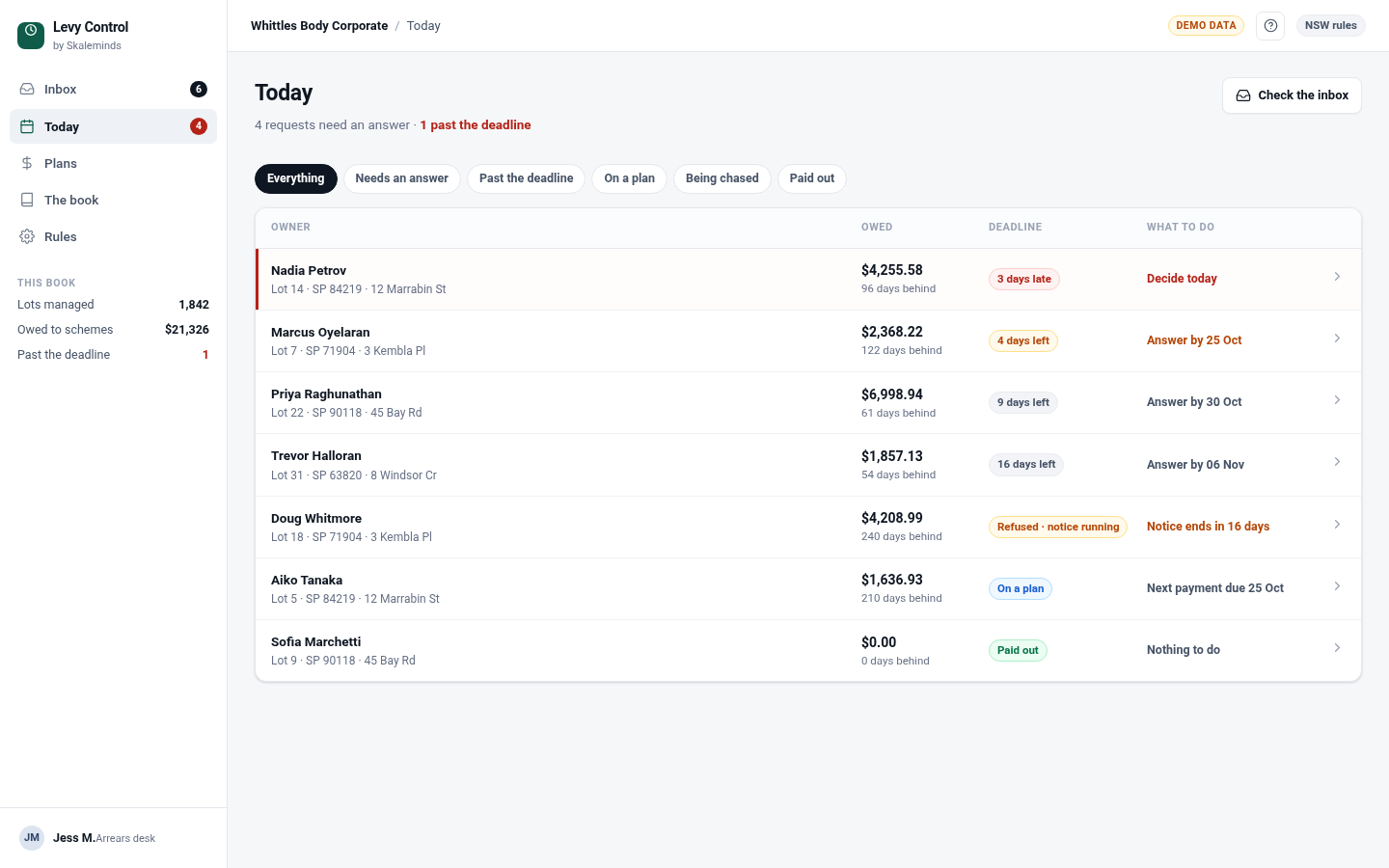
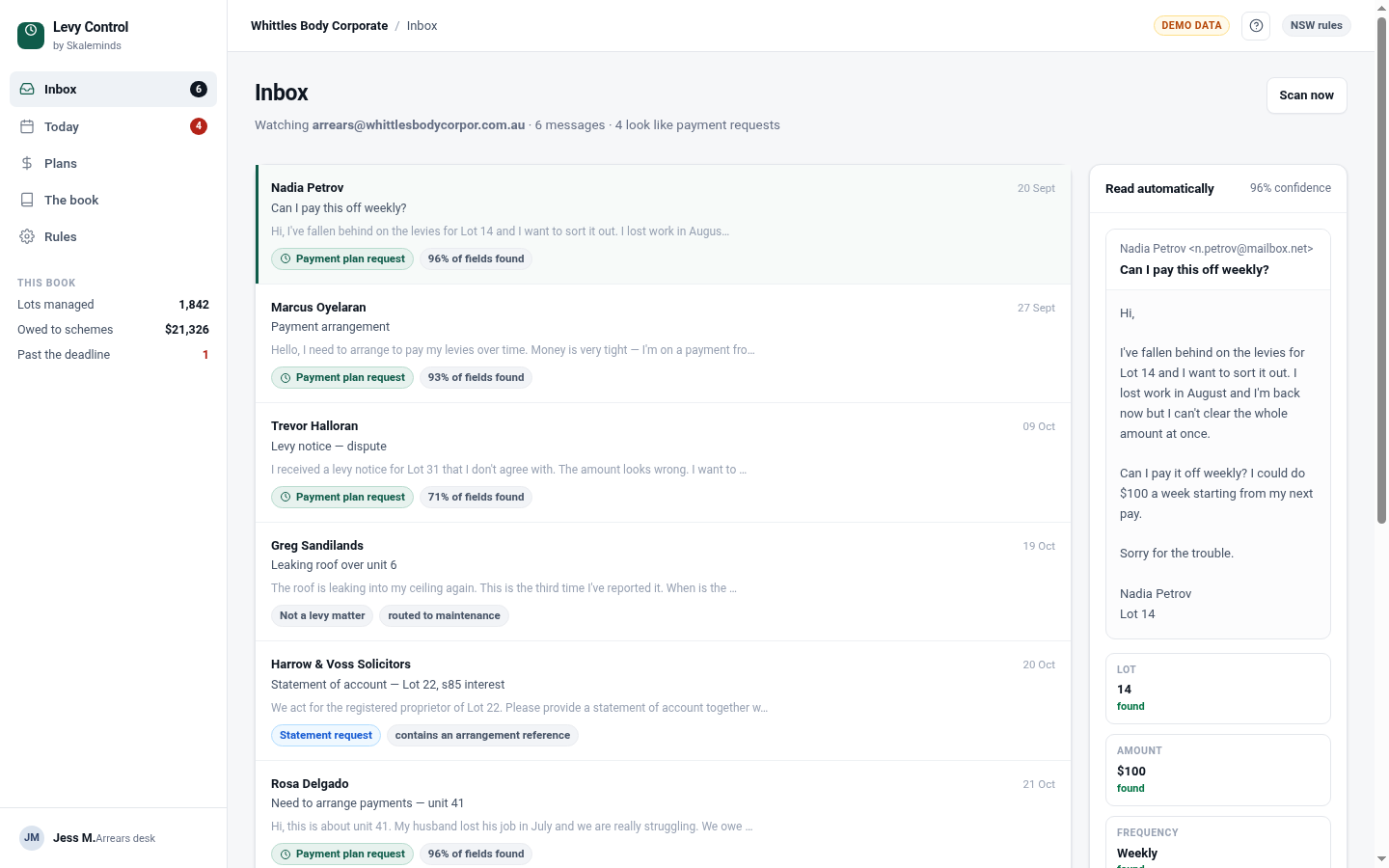
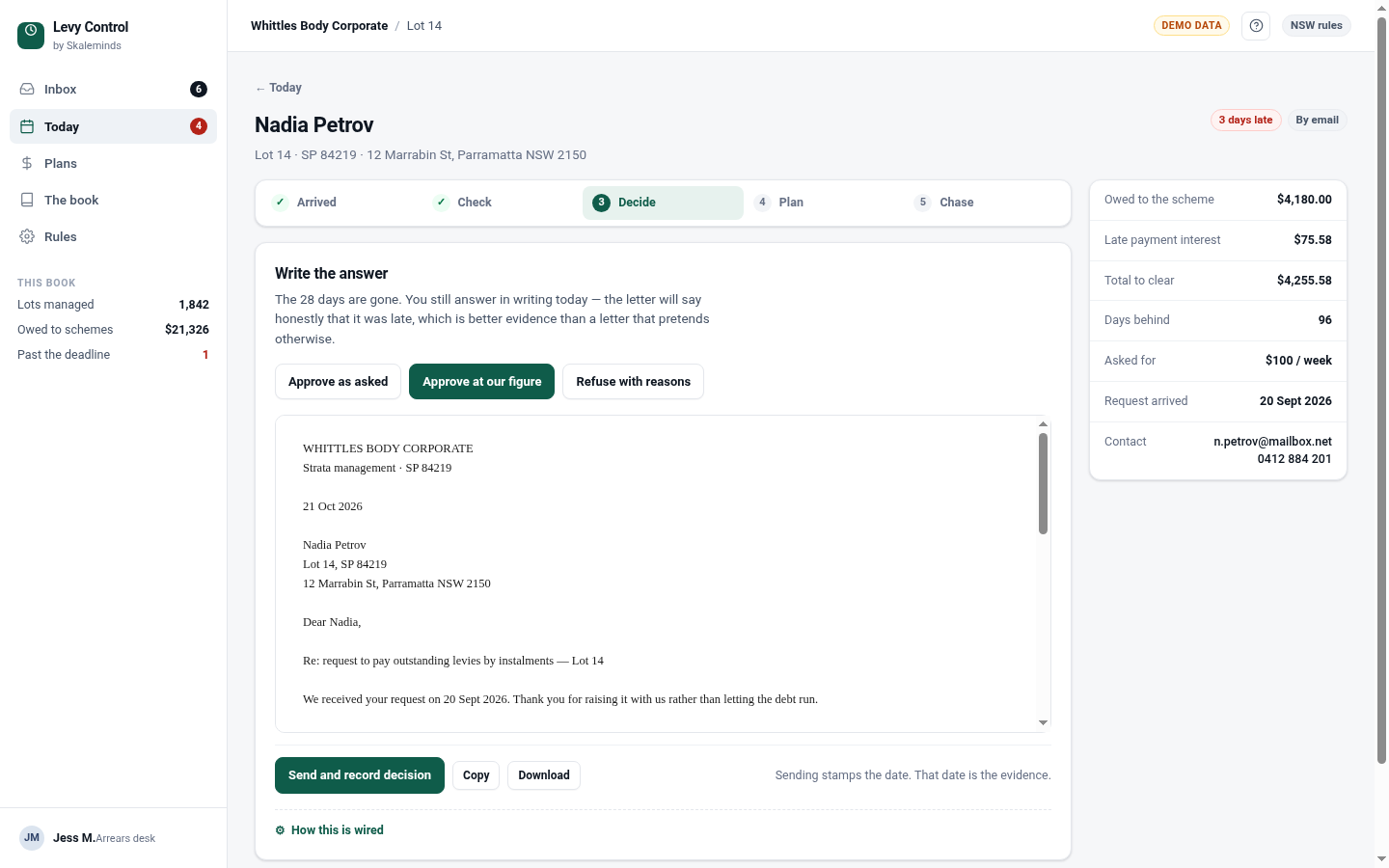
Since 27 October 2025, a NSW owner's request to pay their levies by instalments has carried a legal clock: a decision within 28 days, in writing, with reasons if it is refused, and no fee for asking. The duty sits with the owners corporation. In practice it lands on the strata manager's desk — and the software that runs the ledger has no field for a request. We built the missing layer in a single sprint week: a working tool that reads requests out of the arrears inbox, runs the clock, drafts the letter, and blocks recovery action until the statutory conditions are met.
jig designed and built this tool as a working demonstration against the published NSW rules. It has not been deployed inside a client's book, and the value figures below are modelled from published industry benchmarks, not measured from a client engagement. Every rule it applies is sourced and dated in the sections that follow.
When an owner cannot pay their levies, they can ask to pay them off over time. In NSW that request is no longer a conversation and an email. It is a process with a legal clock attached. The duty sits with the owners corporation, and in practice it lands on the managing agent:
Unpaid levies also carry interest at 10% per annum, simple. That is the arithmetic of the ledger. The 28 days is the arithmetic of a case file — and the two live in different places.
Miss the clock and it does not become a bad debt to chase another day. The owner can take the matter to the Tribunal, and the scheme may end up paying their costs on a debt that was never in dispute.
Australian strata firms run their books on Strata Master, StrataMax, Urbanise or MYBOS, and those systems are genuinely good at what they were designed for: lot records, levy generation, trust accounting, disbursements. Trust accounting is the most tightly audited workflow in the business, and we did not touch it.
The 28-day decision is a different kind of object. It is a request that arrives by email, a clock that starts on receipt, a decision that must be recorded, a letter that must go out, and a gate that holds recovery until all of it is done. A ledger is keyed on lots and periods. A request is keyed on a human being and elapsed time. There is no field for it, and no report that lists the ones nobody answered.
"This record will show in the Lot record but not in Debt Recovery" — and the plan details themselves are entered as free-text notes, while the same help article instructs users to exclude the lot from debt recovery so notices do not go out mid-arrangement.
MRI Strata Master — help article on payment plans, last updated 21 October 2022, five days before the regime commenced
The obligation is not a finance rule, so it cannot be closed by a finance feature. The clock belongs to a case file, and the case file does not exist.
The brief was narrow on purpose: run the statutory decision, and leave the ledger alone. The tool reads the shared arrears mailbox and a ledger export from the existing system. There is no migration, no integration project, and no change to how levies are raised or receipts are issued.
Screenshots of the live tool on a demonstration book of 1,842 lots. You can open it and drive it yourself — the button is at the end of this page.
Management fees are charged per lot and recur, so a softer housing market does not cut a strata firm's revenue — it slows new scheme wins. What is actually compressing the margin is the cost of the people doing the work:
Source: Macquarie Bank 2026 Strata Industry Benchmarking Report, covering more than 200 firms and 1.4 million lots. The same report puts the best-performing cohort at 470 lots per employee — a gap of about 13% between the middle of the market and the top.
That makes labour productivity the only lever with real money in it. Which is why a tool like this is measured against lots per employee rather than hours saved:
Modelled, not measured. The arithmetic above runs published benchmark ratios against a hypothetical book. It is not a claim about what any client has saved. What it establishes is the size of the prize: one workflow that returns a fraction of one percent of productivity pays for its own build several times over.
This is what a jig sprint looks like when the problem is a rule rather than a report. Five things carried it:
The rule was read, not assumed. Every obligation in the tool traces to a published provision with a commencement date. Getting the rule wrong in code is worse than having no tool at all.
It works beside the system of record. The ledger stays the ledger. A CSV export and a mailbox are the whole integration surface — no migration, no data cleanse, no parallel accounting.
The letter is the audit trail. The date a decision was sent is the evidence that the clock was met. That makes the document the product, not an afterthought.
It is honest about what it does not know. Missing fields stay missing, late letters say they are late, and reasons that are not true cannot be selected. Software that drafts legal correspondence has to fail visibly.
One week, not one quarter. The whole tool was a single sprint week, because the scope was one workflow and one set of rules rather than a platform.
If a rule, a deadline or a decision in writing is living in someone's inbox and memory, it can usually be made into a tool in a week. That is the work.